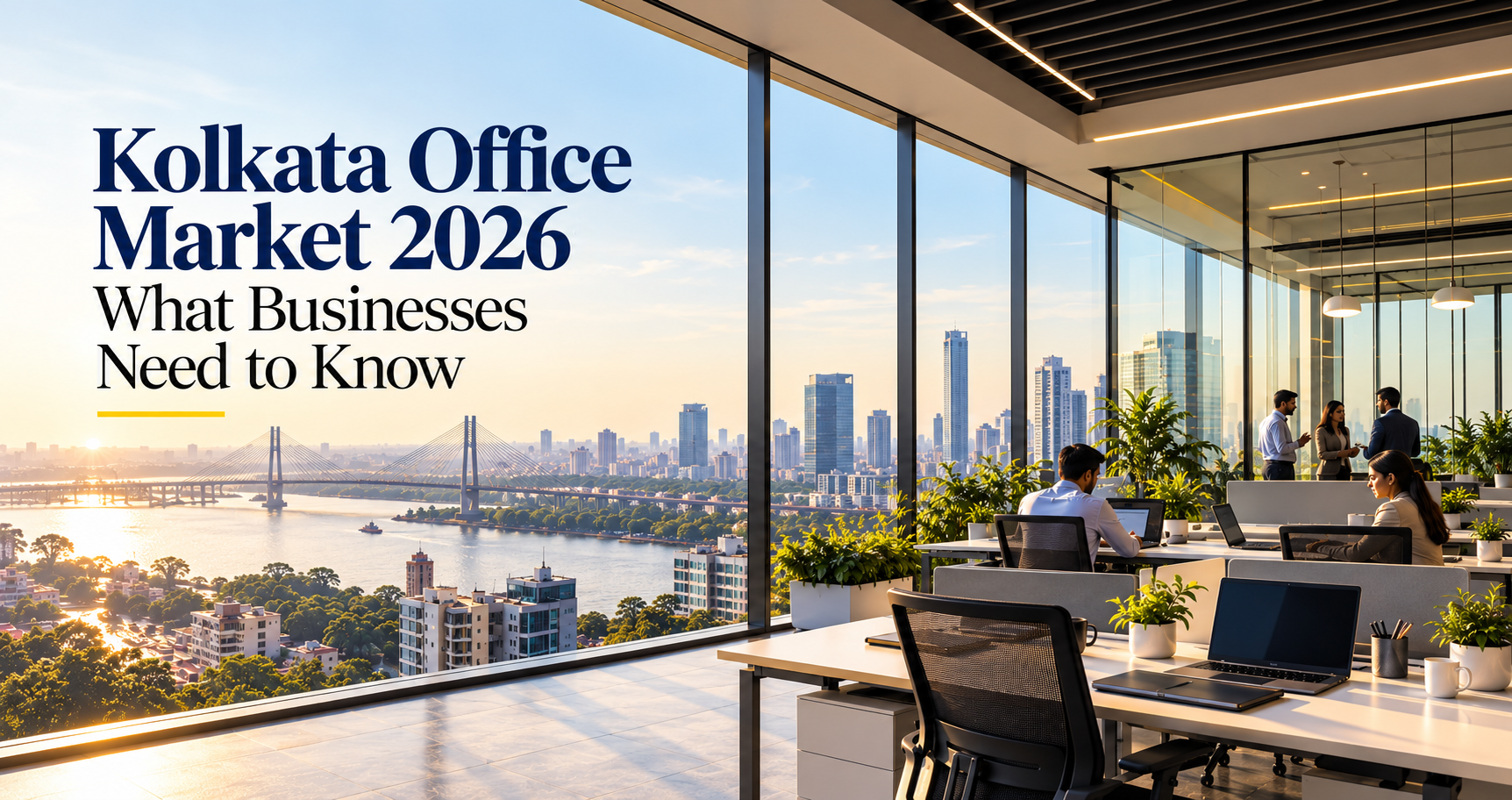
Kolkata’s office market is growing, but at a more measured pace
During Q2 of 2026, 0.2 million sq ft of gross office leasing was recorded in Kolkata and Rajarhat made up much of the additions to new supply. H1 2026 saw 0.8 million sq. ft. of office deals in Kolkata, down 26% YoY. However, average office rents rose 15% to ₹51.1/sq. ft./month, while vacancies declined to 27.5%, indicating steady market demand.
This combination is important: slower transaction volumes do not necessarily mean weaker occupier interest. Instead, businesses appear to be taking a more careful approach to office commitments while quality locations continue to command stronger pricing.
GCCs are adding a new layer to Kolkata’s office demand
Another significant trend in India's office sector includes the continuous growth of Global Capability Centres (GCCs).They are dedicated facilities established by multinational companies for functions such as technology, finance, R&D, and engineering. In H1 2026, GCCs leased 16.6 million sq. ft. across India's top seven cities, accounting for 46% of Grade A office take-up. This demand is expected to reach 35–40 million sq. ft. annually over the next two years, with Kolkata among the key markets.
Kolkata is also beginning to show the impact locally. Grade A net absorption is said to have risen from 0.45 million square feet in H1 2025 to 0.5 million square feet in H1 2026, registering an increase of 11% on a year-on-year basis. The consequence for business is clear. With the growth of GCCs and technology-driven firms, the demand could shift towards office spaces that provide quality infrastructure, connectivity, scaleable floor plates and talent.
Technology and AI are becoming part of Kolkata’s office story
The changing nature of occupier demand is also visible through corporate technology investments. In June 2026, TCS launched India's first Oracle AI Data Platform Lab and Center of Excellence in Kolkata, located at Delta Park Lords. The facility will enable enterprise transformation through AI and complex uses of data and automation. One month later, TCS and Google Cloud opened a Gemini Experience Center in Kolkata targeting consumer enterprises and the use of agentic AI. TCS referred to the experience center as a space for organizations to co-innovate, test, and scale AI-based solutions.
LTM also set up a Global Delivery & AI Competency Center in Kolkata in August 2026, further strengthening its technological and delivery capabilities in the city. None of these should be immediately construed as evidence that all tech companies will add to their footprint in Kolkata. However, they do indicate a broader shift towards higher-value technology, AI and global delivery functions in the city's business ecosystem.
Flexible workspace is becoming more relevant
The other important trend is that of flexible workspace. The total number of leased seats for flexible workspace players in the top eight cities of India amounted to 191,306 in H1 2026, marking a YoY growth of 68.4%. The figure for Kolkata was 3,454 seats of flex workspace in H1 2026, compared with 2,334 seats in H1 2025, which is a 48% rise. Flexible workspaces offer businesses a cost-effective alternative to traditional leases, while managed offices provide workspace, infrastructure, and operational support, enabling organizations to focus on growth.
What should businesses consider before choosing office space in Kolkata?
The trends for 2026 show that businesses need to look beyond rent.
- 𝐋𝐨𝐜𝐚𝐭𝐢𝐨𝐧 𝐚𝐧𝐝 𝐜𝐨𝐧𝐧𝐞𝐜𝐭𝐢𝐯𝐢𝐭𝐲: Salt Lake City and Rajarhat New Town continue to be important transaction centers, but Rajarhat continues to see increases in supply.
- 𝐒𝐜𝐚𝐥𝐚𝐛𝐢𝐥𝐢𝐭𝐲: If you are anticipating headcount growth, you need to find out if you will have room to grow without needing another move.
- 𝐓𝐨𝐭𝐚𝐥 𝐨𝐜𝐜𝐮𝐩𝐚𝐧𝐜𝐲 𝐜𝐨𝐬𝐭: Rent is not the whole story. You need to consider fit-out costs, utility costs, maintenance, technology, furniture, and workspace management.
- 𝐅𝐥𝐞𝐱𝐢𝐛𝐢𝐥𝐢𝐭𝐲: An increase of 48% year-over-year in Kolkata's flex seat take-up shows there is an appetite for flexible workplaces.
- 𝐁𝐮𝐬𝐢𝐧𝐞𝐬𝐬 𝐞𝐜𝐨𝐬𝐲𝐬𝐭𝐞𝐦: Proximity to talent, customers, transportation, and other businesses is part of the equation.
Kolkata's commercial real estate outlook
Kolkata's 2026 office market is becoming more selective and strategic, with businesses prioritizing flexibility, cost efficiency, and quality spaces over traditional leasing models. While leasing volumes may be lower, there are higher rentals and lower vacancy rates at the same time, while GCC, technology, and flexible workspaces continue to drive occupier demand. In addition to this, infrastructure and logistics form another important aspect of the overall business landscape. The Government of India presented a proposed ₹19,209 crore maritime investment pipeline for West Bengal up until 2031, which will enhance the state's position as an eastern maritime and logistics hub. The lesson to learn for businesses looking into Kolkata office spaces is therefore quite straightforward – their strategy needs to consider not just costs but also location and access to the business environment of the city.
Final Thought
There is a dual trend within Kolkata's commercial real estate in 2026 which is a positive one in the whole. Office sales have come down compared to last year, but rent generation and Grade A absorption have been robust, along with flexible space, GCC, and technology-based investments creating another dimension.
This is good for companies to reevaluate their need for office space at the end of 2026 in terms of quantity, location, and the pace of changing need. An office strategy based on flexibility and scalability will suit them well in light of the market scenario.