CAPEX-Light Growth: Scale Without Heavy Investment
Reports by Knight Frank and CBRE indicate that enterprises can save 15"45% by choosing flexible or managed office models compared to traditional leasing. These savings are primarily driven by avoiding massive upfront fit-out costs and high initial capital expenditure (CAPEX).
Instead of micromanaging a multi-crore construction project, businesses can subscribe to a fully serviced suite. This allows companies to pay as they grow and reallocate vital capital toward expansion or talent acquisition.
Tech-Enabled Meeting Rooms: More Than Just Spaces
In today"s hybrid world, meeting rooms are productivity hubs. Modern managed office space providers offer VC-ready endpoints, wireless screen sharing, and occupancy sensors. Some advanced systems even integrate with EHS compliance, reducing permit processing times by up to 35%.
Imagine booking a 12-seater room from your phone that auto-joins a video call on entry while automatically logging usage for compliance records. This level of technical integration is what sets managed spaces apart from standard rentals.
Multi-City Reach and Market Momentum
When companies expand into new cities like Bengaluru, Pune, or Delhi, they often face the headache of dealing with different landlords and mismatched setups. Managed office providers eliminate this by offering a single agreement, reliable infrastructure across all locations, and a unified billing system.
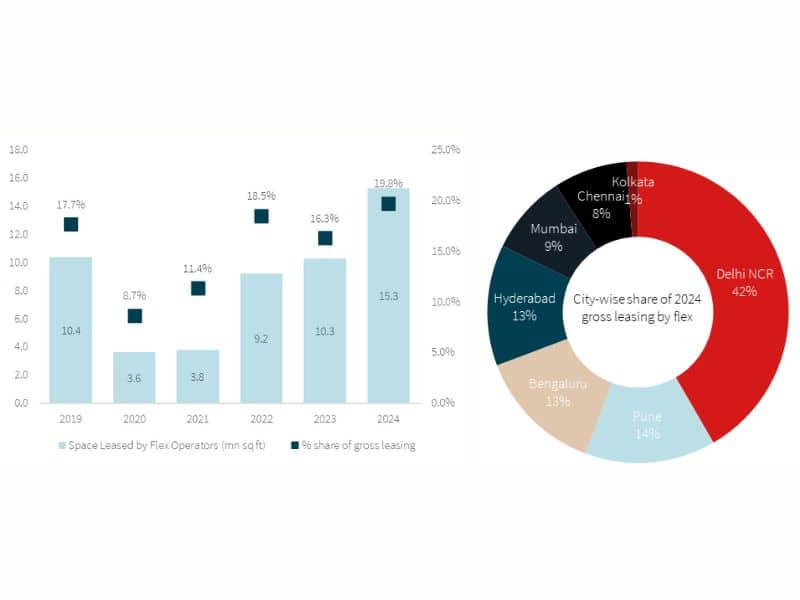
Market data shows that flex office leasing accounted for nearly 20% of total office leasing in 2024. iSprout is a prime example of this momentum, having expanded its Hyderabad operations by adding 1 million sq. ft. of premium managed office space in a single year to meet enterprise-grade demands.
Built for Startups, Ready for Enterprises
With over 1.59 lakh DPIIT-recognized startups in India as of early 2025, the need for affordable yet compliant scaling is critical. Managed spaces support this journey by offering shared setups for early-stage teams that can transition into private, customized suites as the company matures into a full-scale enterprise.
Market Momentum: Why Managed Spaces Are Winning
India's flex office leasing crossed 12.5–15 million sq. ft. in 2024, accounting for nearly 20% of total office leasing (Business Standard). In cities like Bengaluru and Pune, global capability centres are expanding through managed models (Moneycontrol, December 2024)
Final Takeaway
Whether you are a startup, SME, or multinational, the choice between coworking, managed spaces, and traditional leases comes down to speed and scalability. Managed spaces are shaping the future by offering:
- Zero-CAPEX, plug-and-play flexibility.
- Tech-enabled meeting rooms with built-in compliance.
- Multi-city consistency under a single vendor.
- A clear growth path from startup stage to enterprise scale.
Final Thought
As India's office market continues to evolve, managed spaces are clearly the dominant force shaping how businesses work and expand. By ticking the boxes for speed, scalability, and compliance, these environments allow leaders to focus on their core mission while leaving the complexities of facility management to the experts. The era of the 'standard office' is giving way to dynamic, service-oriented workspaces that work as hard as the people inside them.