Speed: launch fast or build it right?
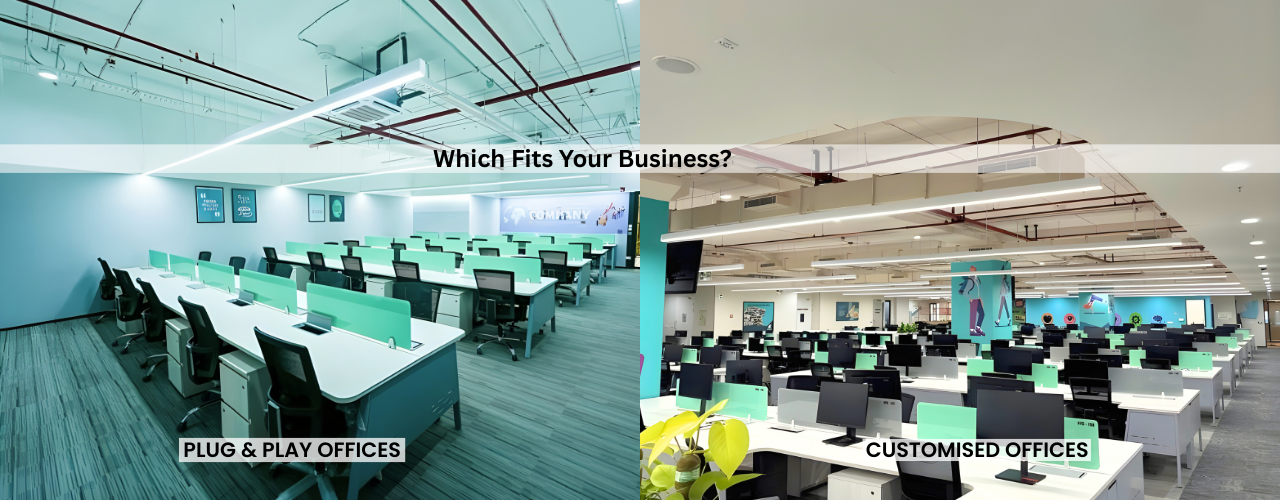
If speed is mission-critical (hiring needs, client deadlines, seasonal operations), plug-and-play wins. Providers advertise same-week or same-month move-ins because the core infrastructure is already in place. By contrast, full fit-outs typically take several weeks to a few months demolition, construction, MEP (mechanical, electrical, plumbing) work, and snagging add up. If you need to be operational fast, ready-to-occupy is the clear choice.
Cost: CapEx vs OpEx and predictable budgeting
Customized fit-outs usually come with a noticeable upfront investment. Between design planning, construction, furniture, and finishing materials, the cost per square foot can feel high at first glance. But when you step back and look at the investment over time, the perspective shifts. Spread across several years of daily use, those initial costs often translate into long term value rather than a short term expense. A well designed office tailored to how your team works can improve productivity, reduce employee turnover, and reinforce your company's brand benefits that quietly deliver strong long-term returns and justify the initial spend.
Plug-and-play shifts the burden into predictable operating expense (OpEx) higher monthly rent but fewer surprise bills and lower initial cash outflow. For cash-constrained or highly uncertain businesses, that predictability and low entry cost can be decisive. Keep in mind that the per-square-foot price for serviced space is typically higher than a bare lease because it includes services and maintenance.
Flexibility & scaling
If you expect headcount to shift rapidly, plug-and-play's flexible contracts and easier expansion/shrinkage are attractive. Providers commonly offer shorter lease terms and the option to add adjacent space within the same building or network.
A custom office can be scalable too, but doing so often comes with lead time and cost: reconfiguring walls or adding infrastructure takes planning and money. For companies with predictable, steady growth and a desire to lock in a bespoke environment, a custom fit-out makes more sense. For companies like startups, project teams, or firms testing new markets plug-and-play is lower-risk.
Brand, culture and productivity
Your office is a physical expression of your culture. If your brand, confidentiality needs, or unique operational workflows require bespoke spaces (specialized labs, secure rooms, client-facing suites), custom fit-outs let you build to spec. Thoughtful design can boost collaboration, reduce noise, and improve task-specific flows - which is hard to replicate in a generic serviced space.
Plug-and-play providers are improving offerings (branded signage, optional customizations), but intrinsic limitations remain: shared common areas, standard furniture, and provider-controlled aesthetics. If the physical workspace is central to your talent strategy or client experience, customization might be worth the investment.
Operations, Admin burden, and Hidden costs
Managed offices remove much operational friction: reception, cleaning, security, and facilities management are handled for you. That saves HR and office-manager time and often reduces unexpected bills (e.g., urgent repairs).
With a custom fit-out you get full control - and full responsibility. Budget for ongoing facilities costs, vendor management, and potential downtime during upgrades. Many companies underestimate the recurring operational headcount or third-party fees required to keep a custom space running at a high level.
Compliance and technical infrastructure
If your business requires specialized technical infrastructure (server rooms, specific HVAC, heavy power loads, or compliance controls), a custom build lets you install to spec.
Plug-and-play offices often provide good baseline IT and internet but may not meet regulatory or technical needs for some industries (fintech, healthcare with PHI, certain R&D).
Evaluate vendor SLAs for power, internet redundancy, and data security before committing.
Decision checklist: which should you pick?
Use this quick scoring system: give yourself points and see which total is higher.
- Need to move in immediately or within weeks?
- Predictable headcount and need for a highly branded space?
- Cash conservation and preference for OpEx over CapEx?
- Specialized technical or compliance requirements?
- Preference for short-term flexibility (6–18 month horizon)?
- Want full control over long-term workplace investment and culture?
Add up the points: higher score for plug-and-play suggests a managed office; higher for custom suggests a fit-out. If it's a tie, consider a hybrid approach: lease plug-and-play initially, then design a custom flagship office as you stabilize.
Practical tips before you sign
For plug-and-play: review what's included (IT, cleaning, meeting room hours), SLA on internet/power, and exit terms. Ask about surge pricing for extra meeting-room hours or storage.
For custom fit-outs: get multiple quotes, define a firm timeline, and include contingency (budget + 10–20%). Plan for ongoing maintenance costs and vendor SLAs.
In both cases: model total cost of occupancy over 3–5 years, include hidden costs (furniture refresh, utility overages, fit-out amortization), and factor employee commute and retention impacts.
Final Thought
There's no universally "right" answer - only the right trade-offs for your moment in time. If speed, low up-front cost, and flexibility are priorities, plug-and-play offices are an excellent, lower-risk choice. If your workplace is a strategic asset - a recruiting tool, a client showcase, or a center of specialized operations - investing in a customized fit-out delivers long-term value that's hard to replicate. Whichever path you choose, make the decision explicitly: align the office choice with hiring plans, cash runway, client needs, and the culture you want to build.